UEE · Connu
The birthplace of Humanity and capital of the Empire. The Imperator, Senate and many other major UEE institutions are based on Earth (Sol III). Among the many historical milestones that the system can lay claim to is the first planet terraformed by Humans, Mars (Sol IV).
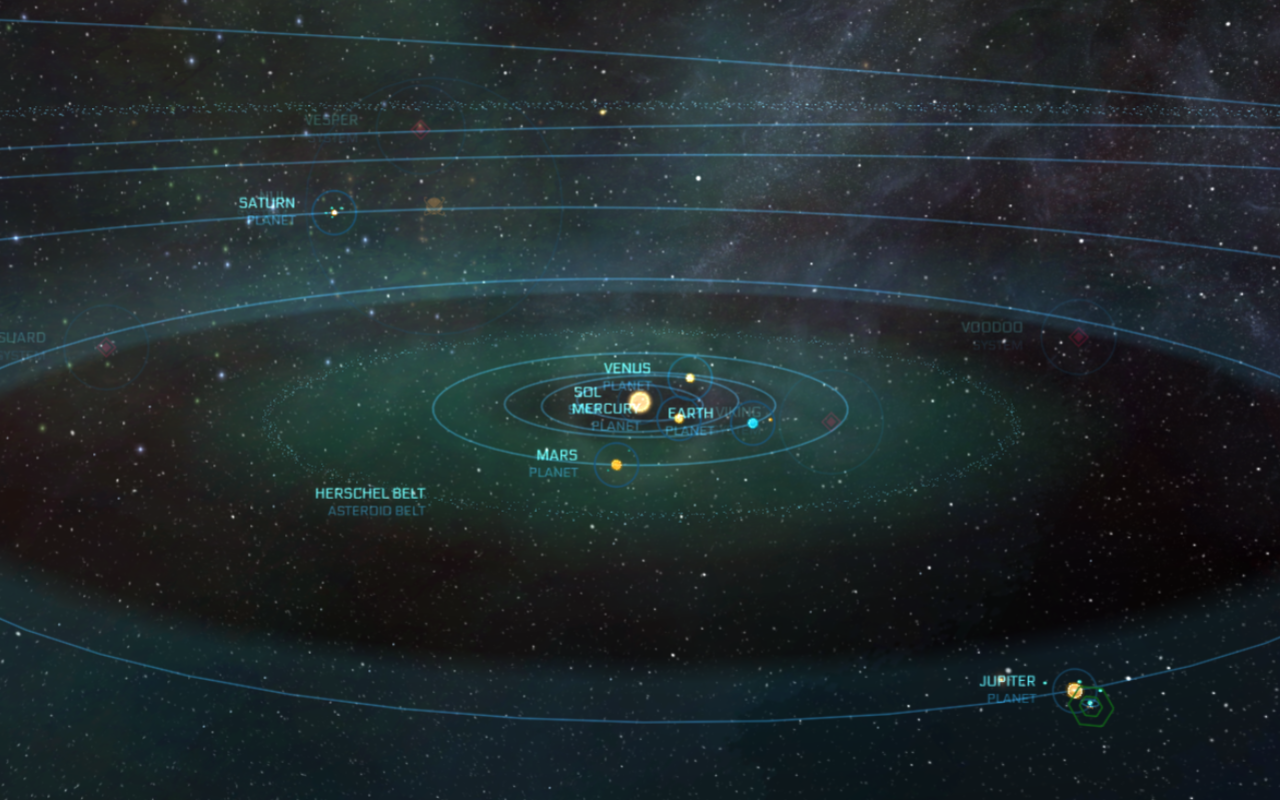
Sol System
Planetary Systems
The Sol system is a planetary system in the United Empire of Earth (UEE) that consists of a G-type main sequence star, one mesoplanet, three terrestrial planets, two gas giants, two ice giants, a dwarf planet, an asteroid belt, and many other celestial bodies. The original home…
Sol
Main Sequence-Dwarf-G
EarthSol III
Terrestrial Rocky · Habitable · UEE
Humanity’s homeworld and namesake of the United Empire of Earth. It is the center of the UEE political machine and a focal point in the Empire’s commerce and culture. Centuries of habitation have stripped the planet of its natural resources resulting in a heavy dependence on imports for the billions that live here.
JupiterSol V
Gas Giant · UEE
This gas giant is the largest planet in the Sol System.
MarsSol IV
Desert Planet · Habitable · UEE
A prosperous and populous planet, Mars was the Empire’s first successfully terraformed planet. The process was marred by what is today known as the Mars Tragedy when a terraforming disaster killed 4,876 people in 2125.
MercurySol I
Iron Planet · UEE
Due to an orbital eccentricity, this small planet experiences the greatest temperature variations of any planet in the system.
NeptuneSol VIII
Ice Giant · UEE
An ice giant whose differential rotation contributes to it having the strongest winds in the Sol System.
PlutoSol IX
Dwarf Planet · UEE
This dwarf planet was the first Kuiper Belt object to ever be discovered and is primarily made of ice and rock.
SaturnSol VI
Gas Giant · UEE
A gas giant best known for its set of planetary rings.
UranusSol VII
Ice Giant · UEE
This ice giant has an unusual lopsided magnetic field due to a dramatic tilt of its axis that places its north and south poles where most other planets have their equator.
VenusSol II
Smog Planet · UEE
Venus’s atmosphere is almost entirely composed of carbon dioxide, which makes it the hottest planet in the Sol System.
ArielSol 7b
Planetary Moon
The surface of this moon is crisscrossed by an extensive network of scarps, canyons, and ridges. Scientists speculate some of these canyons were carved out by liquid ammonia, methane, or carbon monoxide.
CallistoSol 5d
Planetary Moon
The tidally locked surface of Callisto is the oldest and most heavily cratered in Sol.
CharonSol 9a
Planetary Moon
The gravitational influence of Charon on Pluto is such that the pair has been classified and unclassified as a binary dwarf planet multiple times since its discovery in 1978.
DeimosSol 4b
Planetary Moon
With a radius of only 6.2 kilometers, Deimos' size and lumpy shape bear more of a resemblance to an asteroid than a moon.
DioneSol 6d
Planetary Moon
Strangely, this tidally locked moon features numerous impact craters on its trailing hemisphere, leading scientist to speculate that heavy bombardment from objects once spun Dione 180 degrees.
EuropaSol 5b
Planetary Moon
Europa's icy surface makes it one of the most reflective moons in the Sol System.
GanymedeSol 5c
Planetary Moon
Ganymede is the Sol System’s largest moon and the only one with a magnetosphere. It is bigger than Mercury and only slightly smaller than Mars.
IapetusSol 6e
Planetary Moon
Tidally locked to Saturn, Iapetus is unusual because of its “two-tone” coloration. The side facing Saturn is constantly shrouded in shadow while the more distant side is illuminated.
IoSol 5a
Planetary Moon
Thanks to tidal heating, Io experiences extreme geologic activity, making it the driest and most volcanically active object in the Sol System.
LunaSol 3a
Planetary Moon
A large natural satellite that is tidally locked with Earth. The first celestial object Humanity ever visited.
MirandaSol 7a
Planetary Moon
Miranda is one of the smallest objects in the Sol System known to be in hydrostatic equilibrium. Its extreme and varied topography includes the Verona Rupes, which features the tallest cliff in the system.
OberonSol 7e
Planetary Moon
Uranus’ second largest moon was named after a mythical faery king from a famous 16th century play. Its surface is covered in impact craters and appears red in color due to space weathering.
PhobosSol 4a
Planetary Moon
Only 6,000 kilometers away, Phobos orbits Mars so fast that it appears to rise in the west and set in the east twice every Martian day.
RheaSol 6b
Planetary Moon
Made mainly of rock and ice, Rhea is commonly referred to as a “dirty snowball” due to its composition.
TethysSol 6c
Planetary Moon
Tethys is predominantly made of water ice, which gives it a density much lower than other celestial objects its size.
TitanSol 6a
Planetary Moon
Saturn’s largest natural satellite has long been of great interest to scientists. With rivers and lakes of ethane and methane, Titan is the only moon in the Sol System with a dense atmosphere.
TitaniaSol 7d
Planetary Moon
Titania is Uranus’ largest moon. Enormous canyons and scarps cut through its surface. Scientists believe they were created after an interior expansion occurred during the moon’s evolution.
TritonSol 8a
Planetary Moon
The largest of Neptune’s moons, it the planet's only natural satellite massive enough to have achieved gravitational rounding.
UmbrielSol 7c
Planetary Moon
This moon’s name has its roots in the Latin word “umbra”, which means shadow. An appropriate reference considering Umbriel is the darkest of all Uranian moons.
IMS Bolliver
Space Station · Habitable
Though it is no longer in active service since the Marine forces stationed here were reassigned to Mars, the base remains strictly off limits.
INS Dunleavy
Space Station · Habitable · UEE
This orbital Naval base acts as the main operational center for the main Sol fleet.
TDD Kesner
Space Station · Habitable · UEE
A major shipping hub where most cargo moving to Earth is first processed to help alleviate congestion on the Empire’s capital world.
Herschel BeltSol Belt Alpha
System Belt
Over half the belt’s entire mass is concentrated in four large asteroids.
Jovian Rings
Planetary Ring
Planetary Ring System
Kuiper BeltSol Belt Beta
System Belt
The Kuiper Belt consists mainly of small bodies that are believed to be remnants from Sol's formation.
Rings of Neptune
Planetary Ring
Planetary Ring System
Rings of Saturn
Planetary Ring
Planetary Ring System
Rings of Uranus
Planetary Ring
Planetary Ring System
Source : Galactapedia et starmap de RSI, via l'API du Star Citizen Wiki.
